


GO Corporation
GO Corporation was a Foster City, California startup that pioneered pen-based personal computing from 1987 to 1994. Backed by roughly $75 million from Kleiner Perkins, IBM, and others, and led at various points by some of the most consequential operators in Silicon Valley history, GO designed PenPoint OS — an operating system built from first principles around the stylus, with a notebook interface, system-wide gestures, and compound documents — years before the silicon, batteries, and market could support its vision.
The company won BYTE magazine's Best Operating System award for 1992, shipped on the very first IBM ThinkPad (the 700T tablet), spun off a hardware subsidiary called EO that AT&T eventually acquired, and was itself bought by AT&T in January 1994. Two weeks after that acquisition, AT&T canceled the Hobbit processor that anchored EO's hardware, and by July 1994 both companies had been shuttered. Co-founder Jerry Kaplan would later write that GO produced "no meaningful sales" in its seven-year life.
The biography below traces the company from its now-legendary origin on an airline flight in late 1986 through its collapse, the careers of its remarkable alumni, and the ideas it sent forward into the Newton, Palm, Tablet PC, iPad, and Surface.
Organization Details
USA
Jerry Kaplan (founder, chairman)
Robert Carr (CTO; principal architect of PenPoint OS)
Kevin Doren (VP Hardware)
Bill Campbell (CEO)
Randy Komisar (CFO)
Mike Homer (VP Marketing)
Stratton Sclavos (VP Sales)
Omid Kordestani (Sales)
Mitch Kapor (founding investor, board)
PenPoint OS (1991) — operating system designed from first principles around the stylus.
GO Computer — Intel 80286-based reference tablet for developers and evaluators.
GO Software Development Kit — APIs, gesture vocabulary, notebook UI toolkit for PenPoint applications.
BYTE magazine Best Operating System (1992).
PC Magazine Technical Excellence award (1991).
First device to bear the IBM ThinkPad brand: the 700T tablet, running PenPoint OS.
~$75M raised across 1987-1993 - among the most heavily funded startups of its era.
Kaplan's memoir Startup named one of BusinessWeek's top-10 business books of 1995.
2008 patent infringement finding against Microsoft's Tablet PC gesture handling.
Origins on an Airline Flight
The story of GO Corporation begins, by its founder's own account, on an airline flight in late 1986. Jerry Kaplan, then a thirty-four-year-old principal technologist at Lotus Development, was traveling with Lotus founder Mitch Kapor when the conversation turned to the future of personal computing. What if, Kaplan wondered, the next generation of computers did away with the keyboard altogether? What if the machine were the size and shape of a paper notebook, and one wrote on its surface with a pen? By the time the plane landed, Kapor had agreed to back the idea, and within months GO Corporation had been incorporated in Foster City, California. The year was 1987, the same year Apple's John Sculley was circulating his "Knowledge Navigator" vision and a full six years before Apple would ship the Newton. GO was first.1,4
Founders and Founding Team
Kaplan was the public face and chief executive of the venture in its earliest days, but he assembled around him a technical leadership that would prove formative. Robert Carr, formerly chief scientist at Ashton-Tate and architect of the ambitious Framework integrated environment, joined as chief technical officer and became the principal architect of what would become PenPoint OS. Kevin Doren led hardware engineering. Mitch Kapor, while never an operating co-founder, served as catalyst, early funder, and intellectual godfather.1,2
A Remarkable Roster
Within two years GO had attracted what may have been the most remarkable management roster of any startup of its era. Bill Campbell — fresh from Apple and Claris and destined to become the legendary "coach" of Silicon Valley — was recruited as chief executive. Randy Komisar served as chief financial officer and later as a senior executive. Mike Homer ran marketing; Stratton Sclavos ran sales; and a young salesman named Omid Kordestani, later Google's first business hire, walked the halls.2
Investors and Capital
The investors were of a piece with the team. Kleiner Perkins Caufield & Byers, through John Doerr, led the financing; IBM, after long and arduous negotiations Kaplan would later recount in detail, took a substantial corporate stake; State Farm Insurance joined as well. Across multiple rounds between 1987 and 1993, GO would ultimately consume roughly seventy-five million dollars in venture capital, an astonishing sum for a single-product company at the time and a benchmark for ambition in the pre-internet startup economy.1,2,9
PenPoint OS
The product that consumed those millions was PenPoint OS, released to manufacturers in 1991 after nearly four years of intensive development. Carr's design was, and remains, one of the most original operating-system architectures ever brought to market. Where Microsoft would later attempt to retrofit Windows for pen use by bolting handwriting recognition onto a desktop paradigm, PenPoint was conceived from first principles around the stylus. Its top-level user interface was not a desktop but a notebook: tabbed, paginated, with documents bound in sequence as if in a physical binder. Gestures were not a feature but a substrate. A circle selected; a struck-through X deleted; a caret inserted; a horizontal scrub erased — and these motions were honored uniformly by every application because they were enforced at the operating-system level. Documents were compound and nested, anticipating ideas that would resurface in OpenDoc and OLE. Layout was dynamic, so that an application reflowed gracefully between portrait and landscape orientation. A single system-wide address book and a single handwriting-recognition engine served every program at once.3 The trade press recognized the achievement immediately: PenPoint took BYTE magazine's Best Operating System award for 199210 and a PC Magazine Technical Excellence award in 1991.11
Hardware Partners
In keeping with the practice of the time, GO did not intend to manufacture hardware itself. PenPoint was conceived as an operating system in the mold of MS-DOS or, in its ambitions, the Macintosh System Software — a platform on which a fleet of computer makers would compete. For internal development and the use of independent software vendors, GO produced a reference machine, the Intel 80286-based GO Computer, but the production hardware was to come from established names. IBM's first product to carry the now-iconic ThinkPad brand was not a clamshell laptop but a PenPoint tablet, the ThinkPad 700T, announced in 1992. NCR shipped its 3125 and 3130 tablets. GRiD Systems, a pioneer of rugged portables, built its PalmPad line around PenPoint.3,8
A Third-Party Software Ecosystem
A third-party software ecosystem also formed, modest in volume but distinguished in character. Slate Corporation, co-founded by VisiCalc's Dan Bricklin, produced productivity software. Pensoft built the Perspective personal-information manager. FutureWave Software wrote a PenPoint drawing program called SmartSketch, which, after PenPoint's collapse, would be ported to Windows and Macintosh, acquired by Macromedia, renamed Flash, and become for a decade the dominant medium of interactive content on the World Wide Web. The pen software house aha!, the source of what would later become Microsoft's Windows Journal, was likewise a PenPoint shop.3
The EO Spinoff
By 1991, however, fissures had begun to appear in the original strategy. The board, weary of supporting two engineering organizations and worried that the hardware ambition was diluting the operating-system mission, voted to spin off the hardware unit as a separate company, EO Inc., under the leadership of Alain Rossmann, a former Apple Europe executive. EO struck an arrangement with AT&T to use the company's new Hobbit microprocessor, a chip AT&T's microelectronics group had developed in search of a flagship application. In April 1993 EO shipped the AT&T EO Personal Communicator 440 and 880 — large, clipboard-sized devices with cellular modems, microphone and speaker, fax and electronic mail, and PenPoint OS at their core. They are sometimes credited in retrospect as the first true smartphones or "phablets," anticipating by fourteen years the form factor and ambition of the iPhone. Their customers included Andersen Consulting and the New York Stock Exchange. They sold, in total, roughly ten thousand units.5,2
Acquisition and Collapse
AT&T purchased EO outright in 1993. By that point GO Corporation, the software parent, was running out of money, and in January 1994 AT&T bought GO as well, reuniting the two halves of the original company under a single corporate roof. The reunion lasted scarcely two weeks. Late in January 1994 AT&T announced that it was cancelling the Hobbit microprocessor program in its entirety, leaving the EO devices without a future processor roadmap and the parent corporation without any strategic reason to continue subsidizing pen computing at all. EO Inc. ceased operations on the twenty-ninth of July 1994. GO Corporation closed the same month. Kaplan would later write, with the candor that distinguishes his account, that in seven years of operation his company had produced "no meaningful sales."1,2,5
Why GO Failed
Why GO failed has been debated ever since, and the answer is overdetermined. The hardware of the early 1990s was simply not equal to the vision: the available x86 processors ran hot, the batteries were heavy and short-lived, the screens were dim and reflective, and a finished PenPoint tablet retailed for something close to three thousand 1992 dollars. Handwriting recognition, while serviceable for printed block letters, never matched the unforgiving expectations the marketing of the period had set, particularly for cursive script. The genuine demand that did exist was vertical — for insurance adjusters, parcel-delivery dispatchers, hospital floor staff, field surveyors — and was too narrow to support a horizontal operating-system company with eighty employees and a hundred-million-dollar burn. Apple's Newton, announced in 1992 and shipped in 1993, absorbed what consumer attention pen computing might have commanded.1,7
The Microsoft Question
And then there was Microsoft. In passages that have entered Silicon Valley folklore through Kaplan's memoir, GO held early technical discussions with Microsoft under non-disclosure agreement; Microsoft subsequently announced its own product, Pen Windows (later Windows for Pen Computing), and applied the considerable pressure available to it on the OEMs whose support PenPoint required. The Federal Trade Commission opened an inquiry into Microsoft's conduct in pen computing as part of its broader antitrust investigation of the company in the early 1990s, although no specific charges arising from the pen episode were ever brought.1,2,6
Aftermath: A Memoir and Two Lawsuits
GO did not vanish without consequence. In 1995 Kaplan published Startup: A Silicon Valley Adventure, a memoir of the seven-year venture that BusinessWeek named one of the ten best business books of the year and that Sony Pictures briefly optioned for film.1 Startup has remained in print continuously and is still assigned in business schools as a paradigmatic case study of well-funded failure. In 2005 a successor entity controlled by Kaplan, GO Computer, Inc., filed an antitrust suit against Microsoft alleging the systematic destruction of GO's market through anti-competitive conduct a decade earlier; the case was ultimately dismissed on statute-of-limitations grounds by the Fourth Circuit Court of Appeals in 2007.6 A separate patent action concluded in 2008 with a finding that aspects of Microsoft's Windows XP Tablet PC Edition gesture handling infringed a GO patent on pen-computer user interfaces.2
The Alumni
The alumni of GO went on to lives so disproportionately influential that the company is sometimes remembered chiefly as a finishing school for Silicon Valley leadership — Bill Campbell as coach to Steve Jobs, Larry Page, and Jeff Bezos; Omid Kordestani as Google's first salesman and senior vice president; Stratton Sclavos as chief executive of VeriSign; Mike Homer as marketing chief at Netscape; Randy Komisar as a partner at Kleiner Perkins. Robert Carr continued to consult on pen software architecture for years afterward, and Jerry Kaplan went on to co-found the online auction company OnSale in 1995 before settling into a second career as an author, lecturer, and adjunct faculty member at Stanford specializing in artificial intelligence.2,4
Legacy
The ideas that GO put into the world did not die with the company. The notebook metaphor, the system-wide gesture vocabulary, the compound document, the uniform ink layer — every one of them reappeared, sometimes openly and sometimes by uncredited adaptation, in the Apple Newton, in Palm OS, in Microsoft's Tablet PC, in the early Windows Mobile devices, and ultimately in the multitouch operating systems of the iPad and Microsoft Surface. GO Corporation, like many companies that mistake the leading edge of an idea for its commercial moment, arrived approximately fifteen years before the silicon, the batteries, the wireless networks, and the public imagination could carry its vision. That it failed is the surface of the story. That so much of what we now take for granted in pen and tablet computing was first thought through, built, shipped, and reviewed within a single mid-sized building in Foster City between 1987 and 1994 is the part of the story worth remembering.2,7
Sources
- Kaplan, Jerry. Startup: A Silicon Valley Adventure. Houghton Mifflin, 1995. The founder's first-person account — primary source for the airline-flight origin, the IBM negotiations, the Microsoft NDA episode, the "no meaningful sales" assessment, and the company's internal life.
- "GO Corporation." Wikipedia. https://en.wikipedia.org/wiki/GO_Corporation
- "PenPoint OS." Wikipedia. https://en.wikipedia.org/wiki/PenPoint_OS
- "Jerry Kaplan." Wikipedia. https://en.wikipedia.org/wiki/Jerry_Kaplan
- "EO Personal Communicator." Wikipedia. https://en.wikipedia.org/wiki/EO_Personal_Communicator
- GO Computer, Inc. v. Microsoft Corp., 508 F.3d 170 (4th Cir. 2007). FindLaw text · CourtListener
- "GO & PenPoint: From the Revolutionary Idea to a Venture Capital Fail." Rare & Old Computers (randoc). PDF
- DigiBarn Computer Museum: PenPoint tablet pen computer by GO Corporation. https://www.digibarn.com/collections/systems/go/
- Harvard Business School case: "GO Corporation." HBS Faculty & Research
- BYTE magazine awards, 1992 (Best Operating System: PenPoint).
- PC Magazine Technical Excellence awards, 1991 (Standards and Operating Systems category: PenPoint).
Artifacts
23 artifacts in the collection
GO Corporation – PenPoint Introduction Program of Events (Handout)
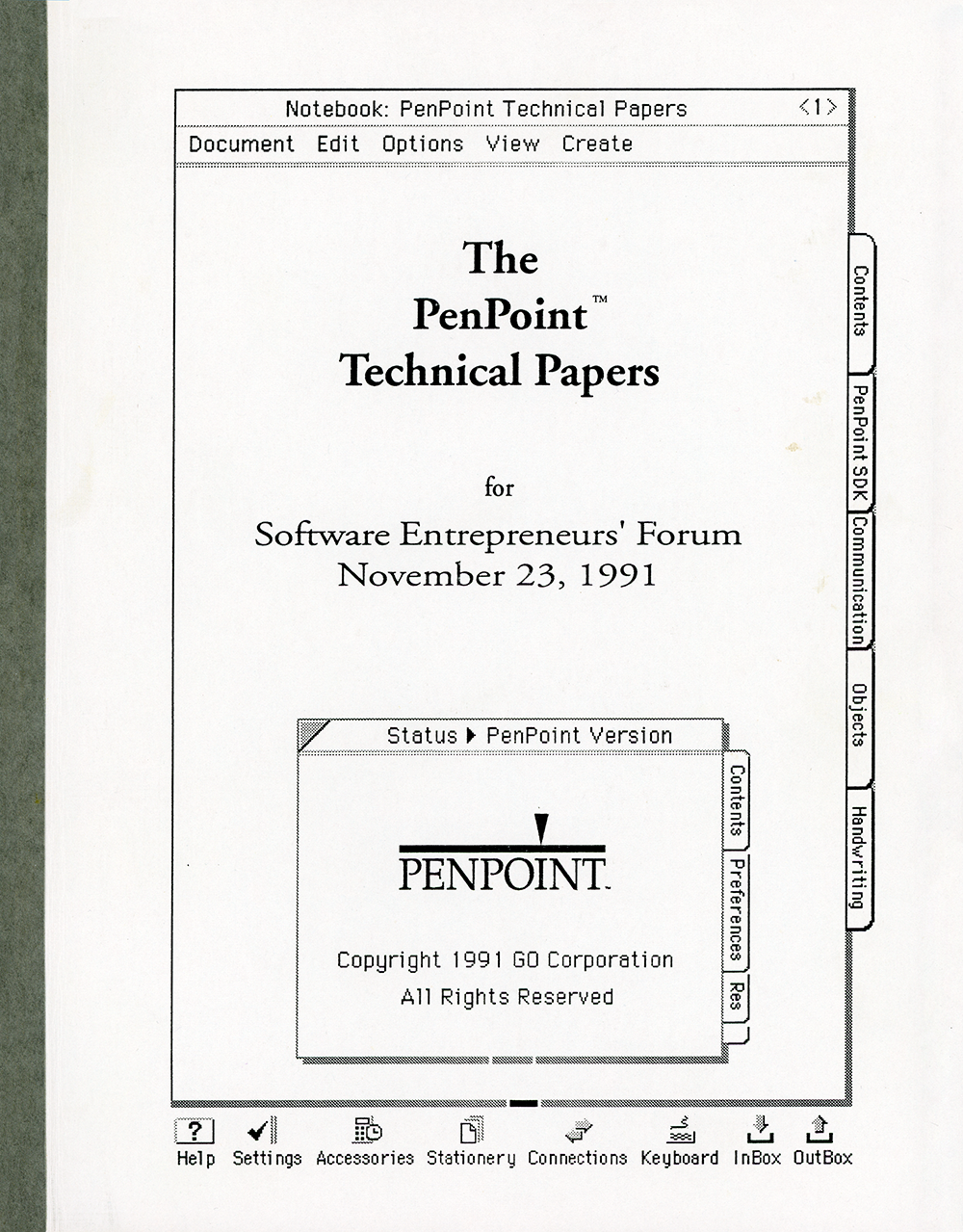
GO Corporation – The PenPoint Technical Papers
WATCOM C Language Reference
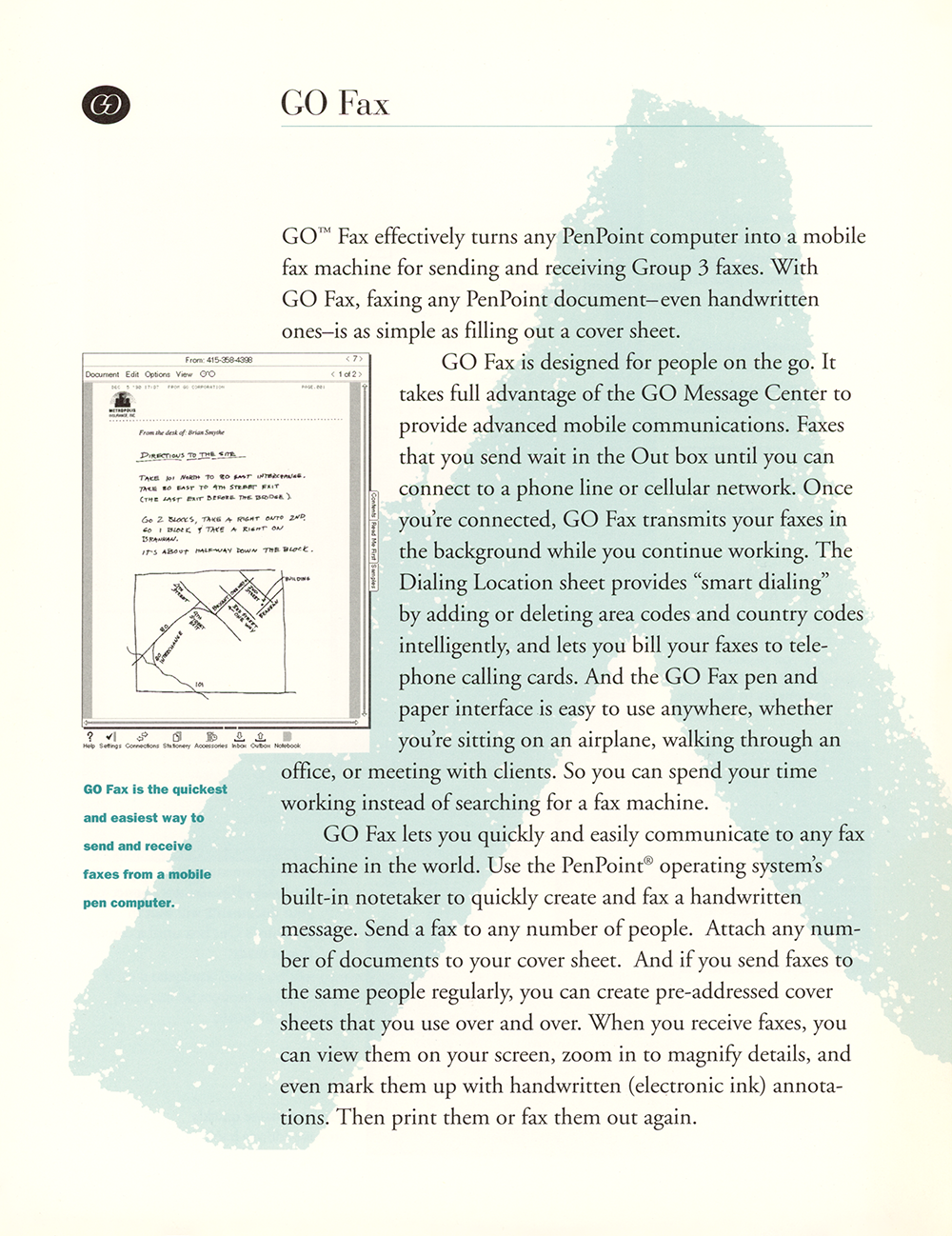
GO Corporation – GO Fax Brochure
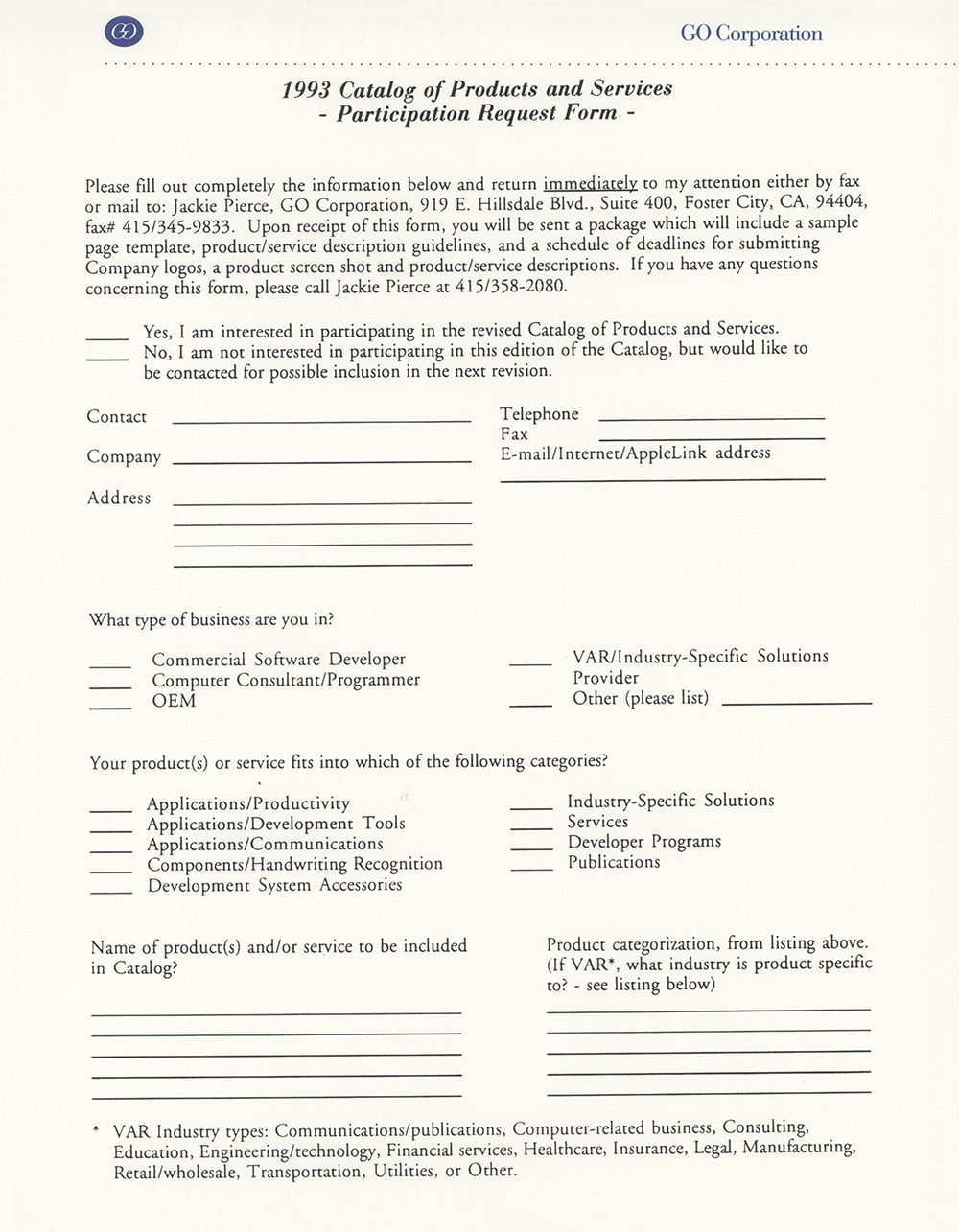
GO Corporation 1993 Catalog of Product and Services Participation Request Form
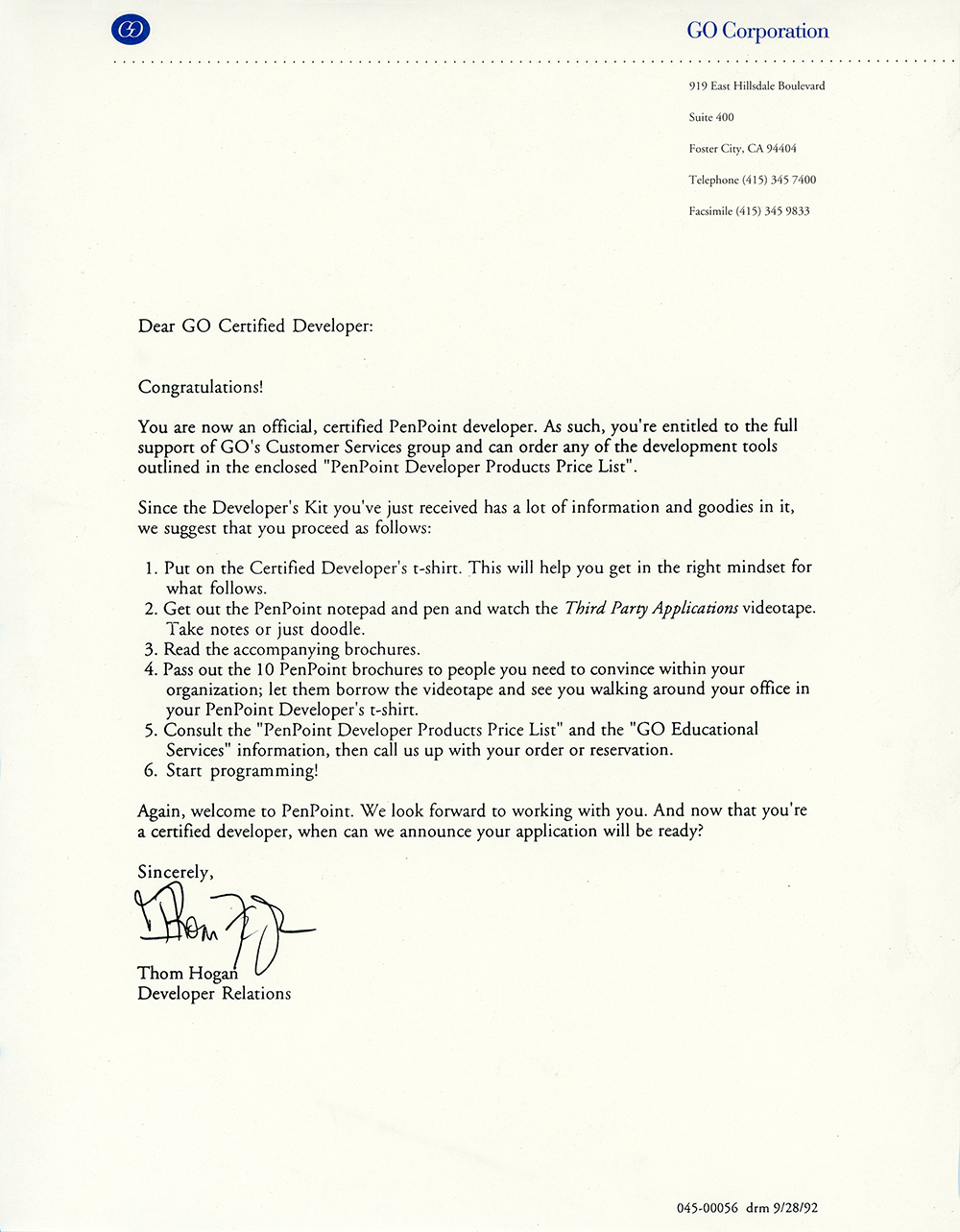
GO Corporation Certified Developer Letter
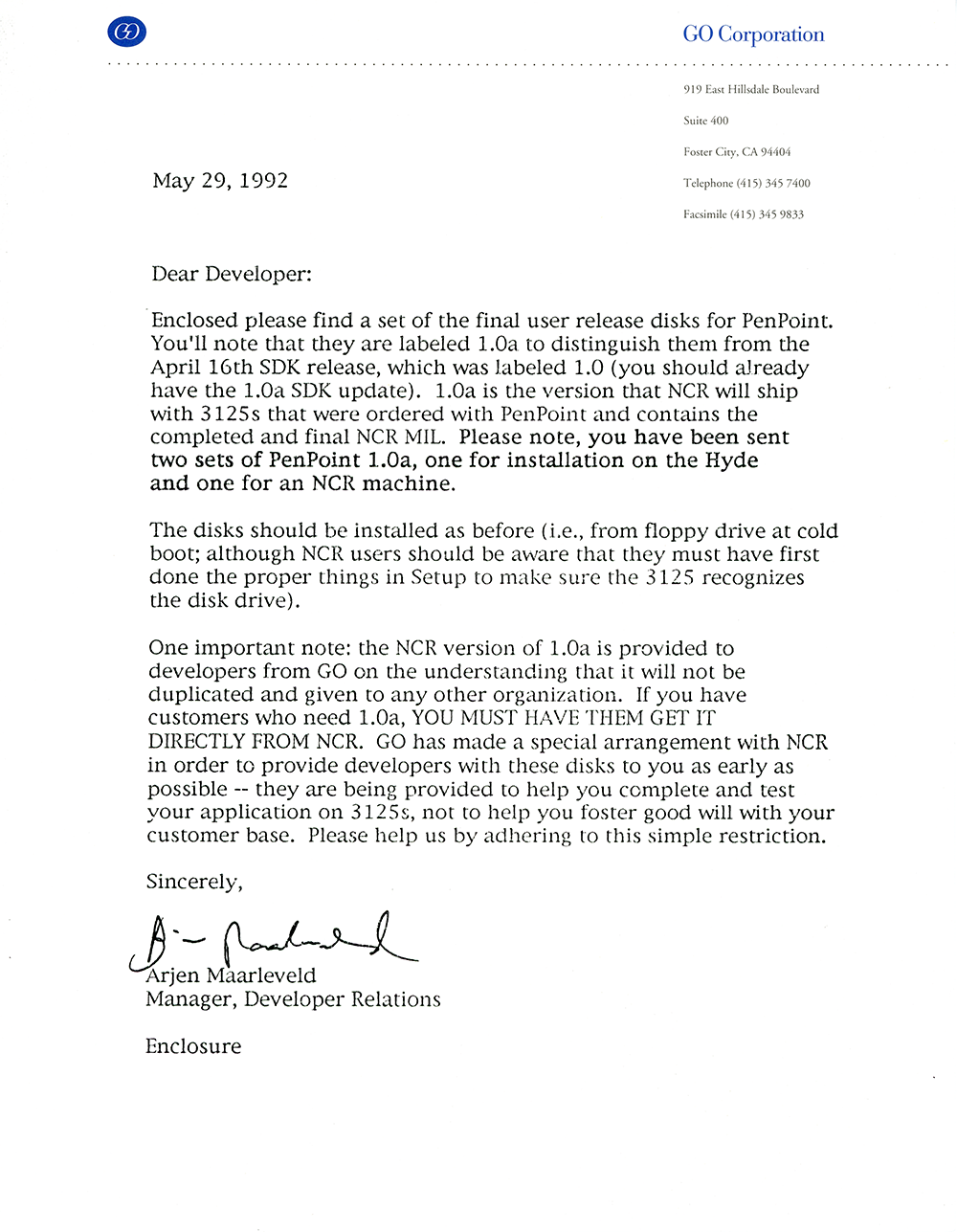
GO Corporation Correspondence – PenPoint SDK 1.0a (May 29, 1992)
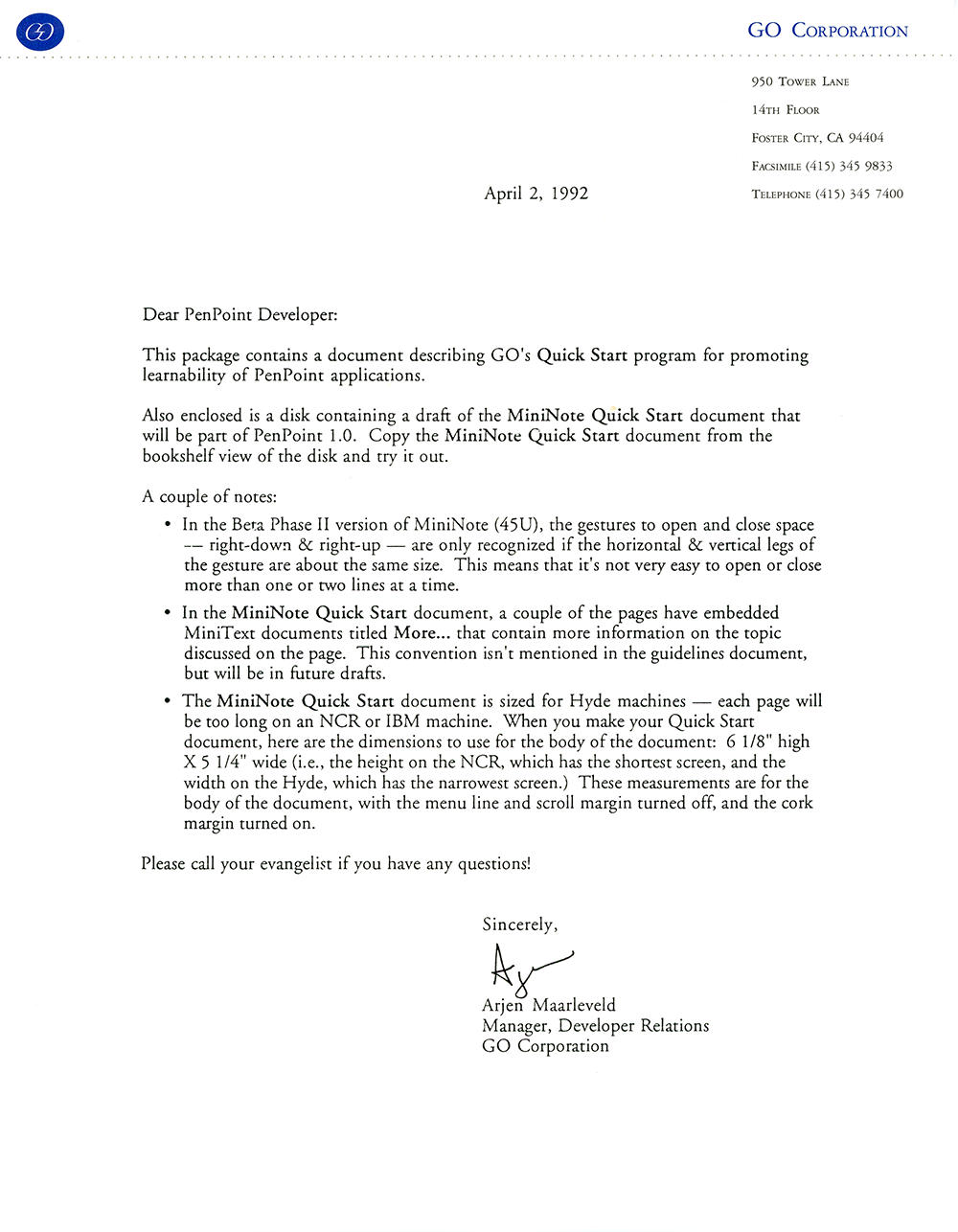
GO Corporation Correspondence – Quick Start Program (April 2, 1992)
GO Corporation Getting Started with PenPoint (Version 1.0)
GO Corporation PenPoint Developer Programs – SDK 1.0 Beta Phase 2 (Open Me First) Package
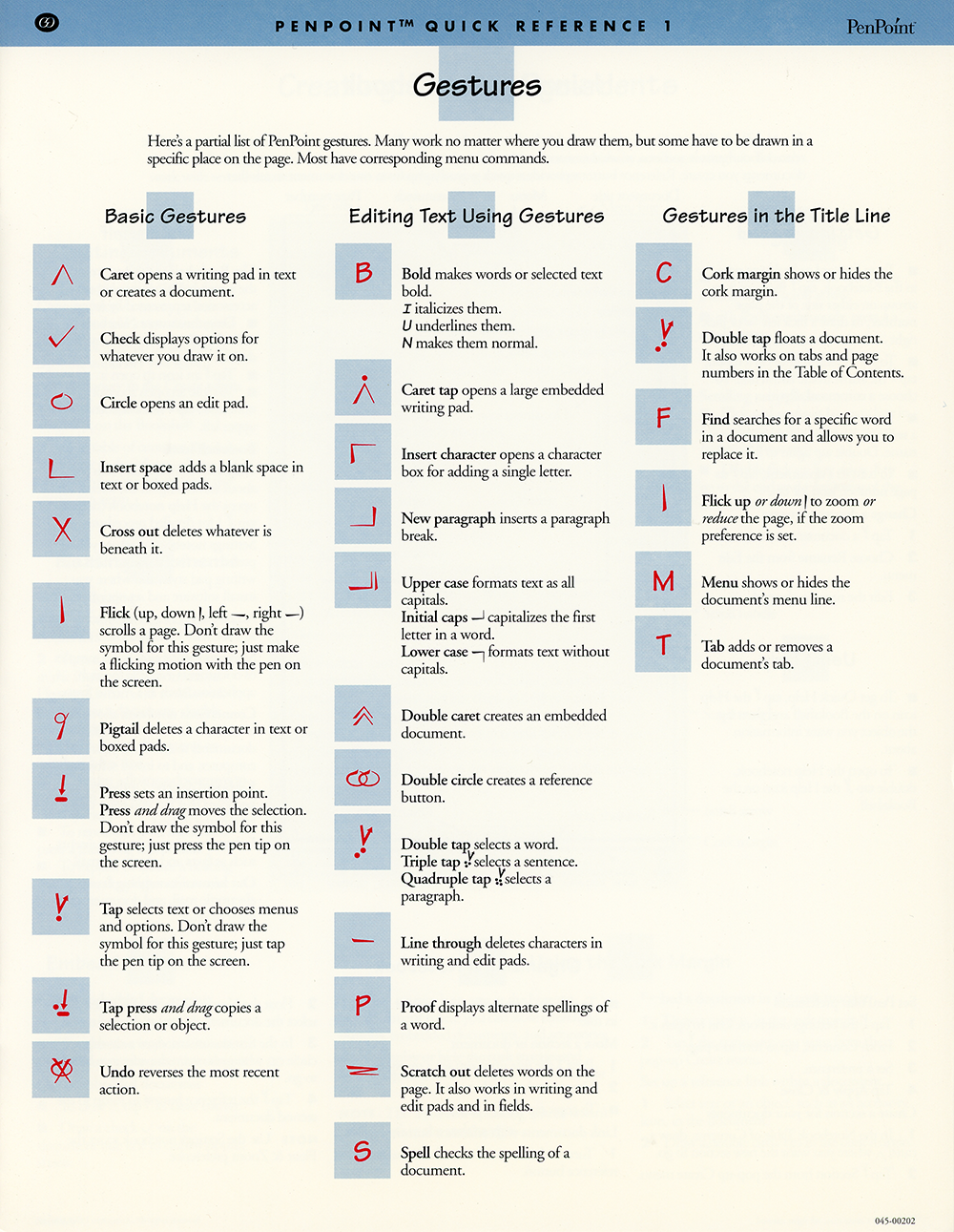
GO Corporation PenPoint Quick Reference
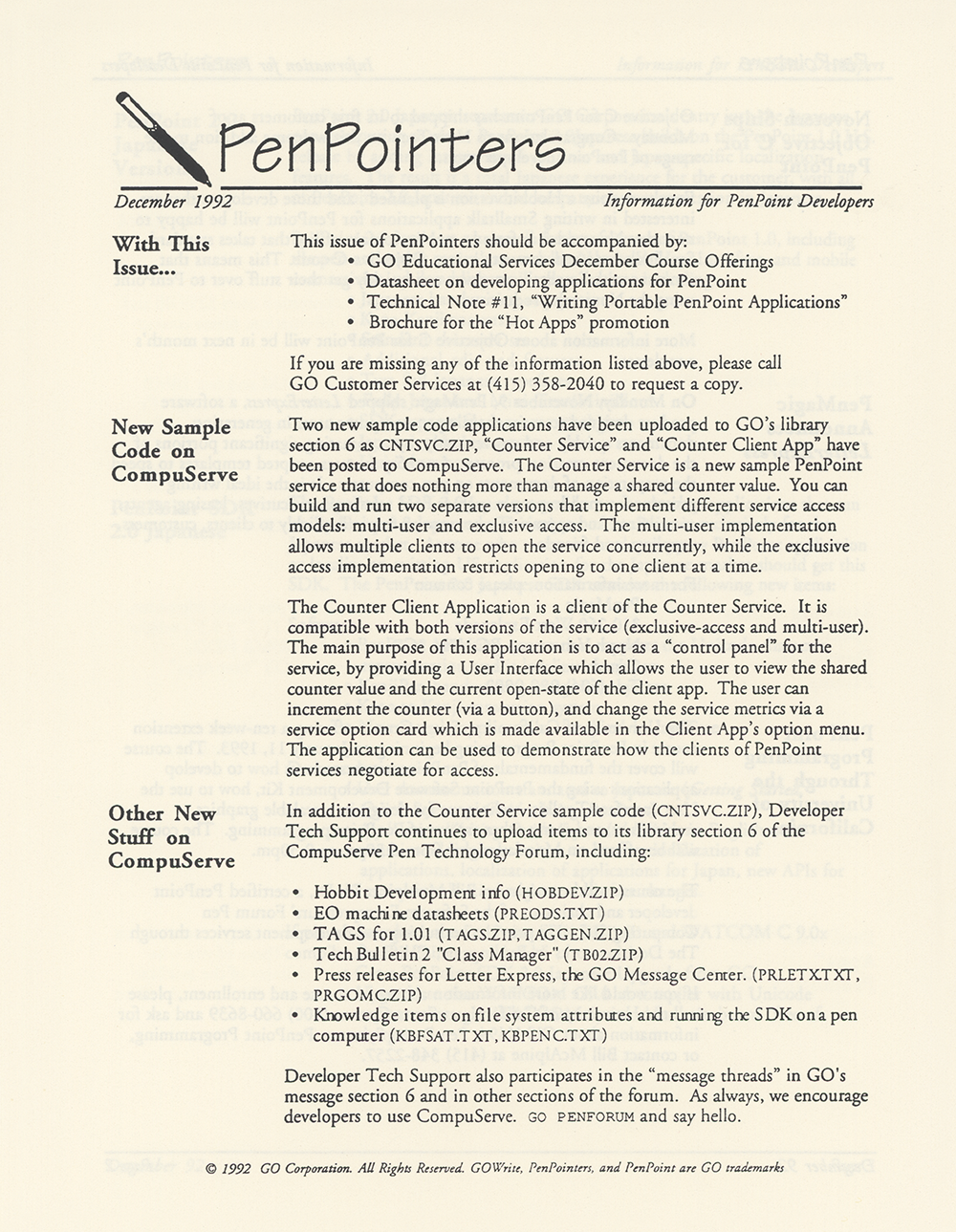
GO Corporation PenPointers December 1992 (Newsletter)
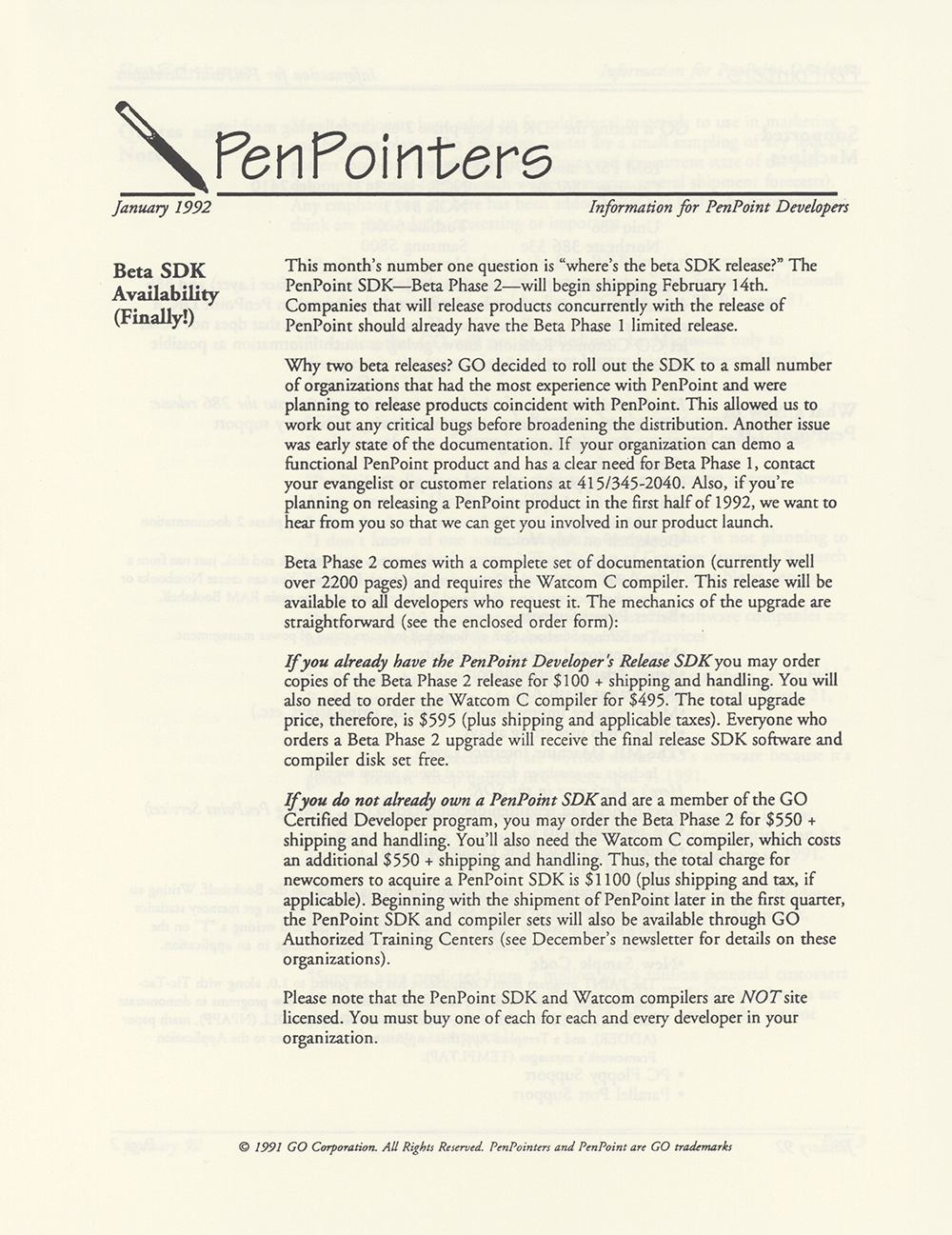
GO Corporation PenPointers January 1992 (Newsletter)
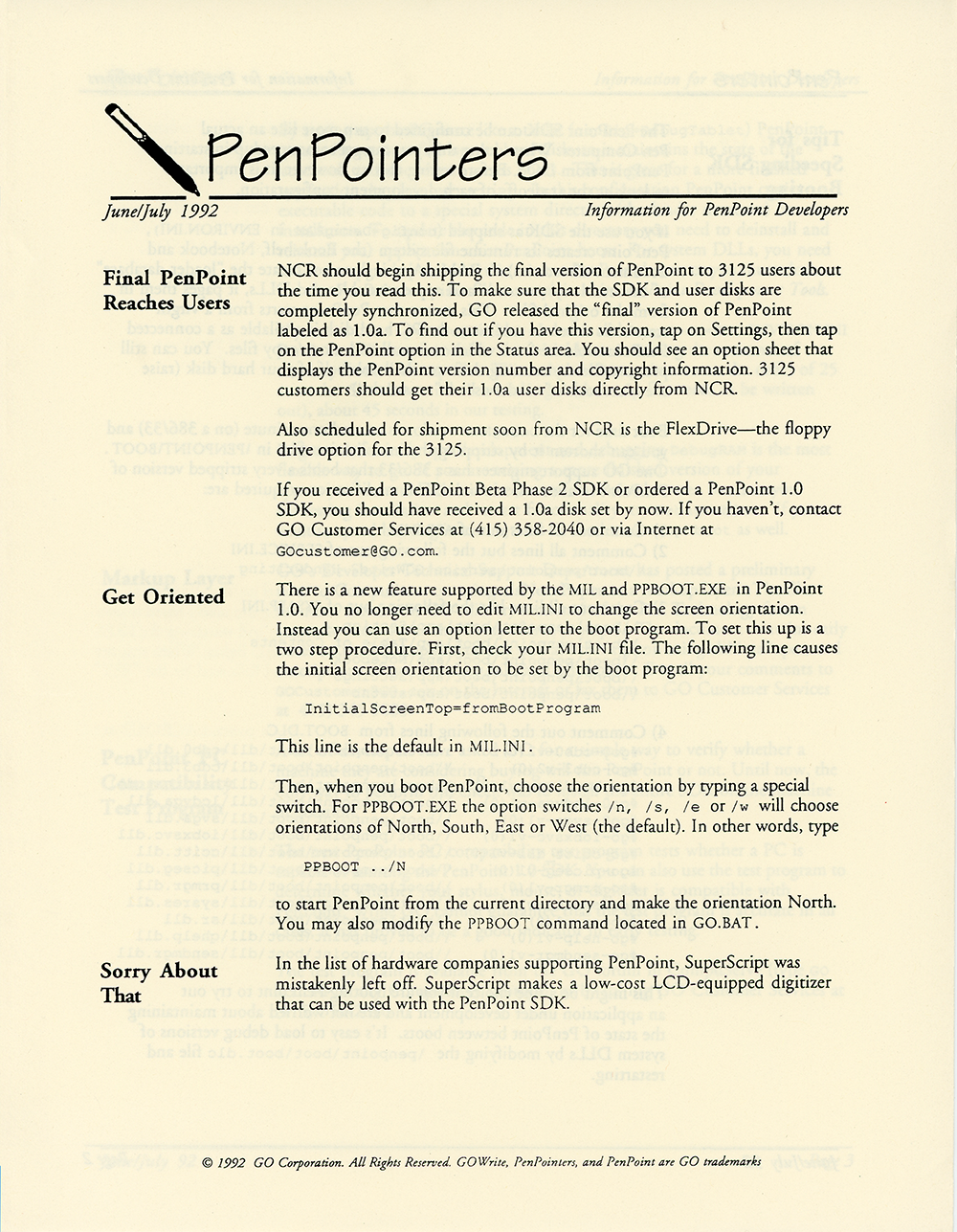
GO Corporation PenPointers June/July 1992 (Newsletter)
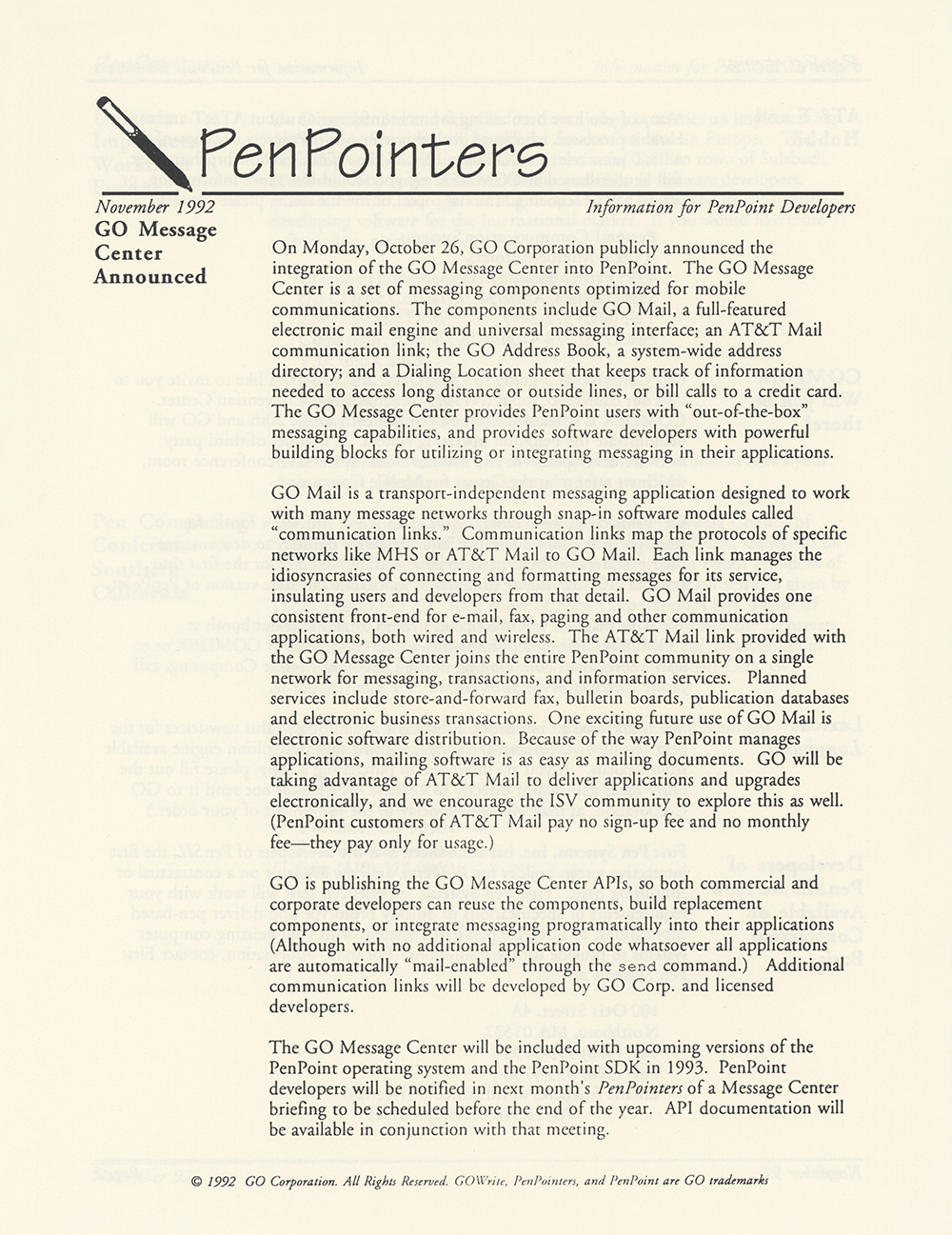
GO Corporation PenPointers November 1992 (Newsletter)
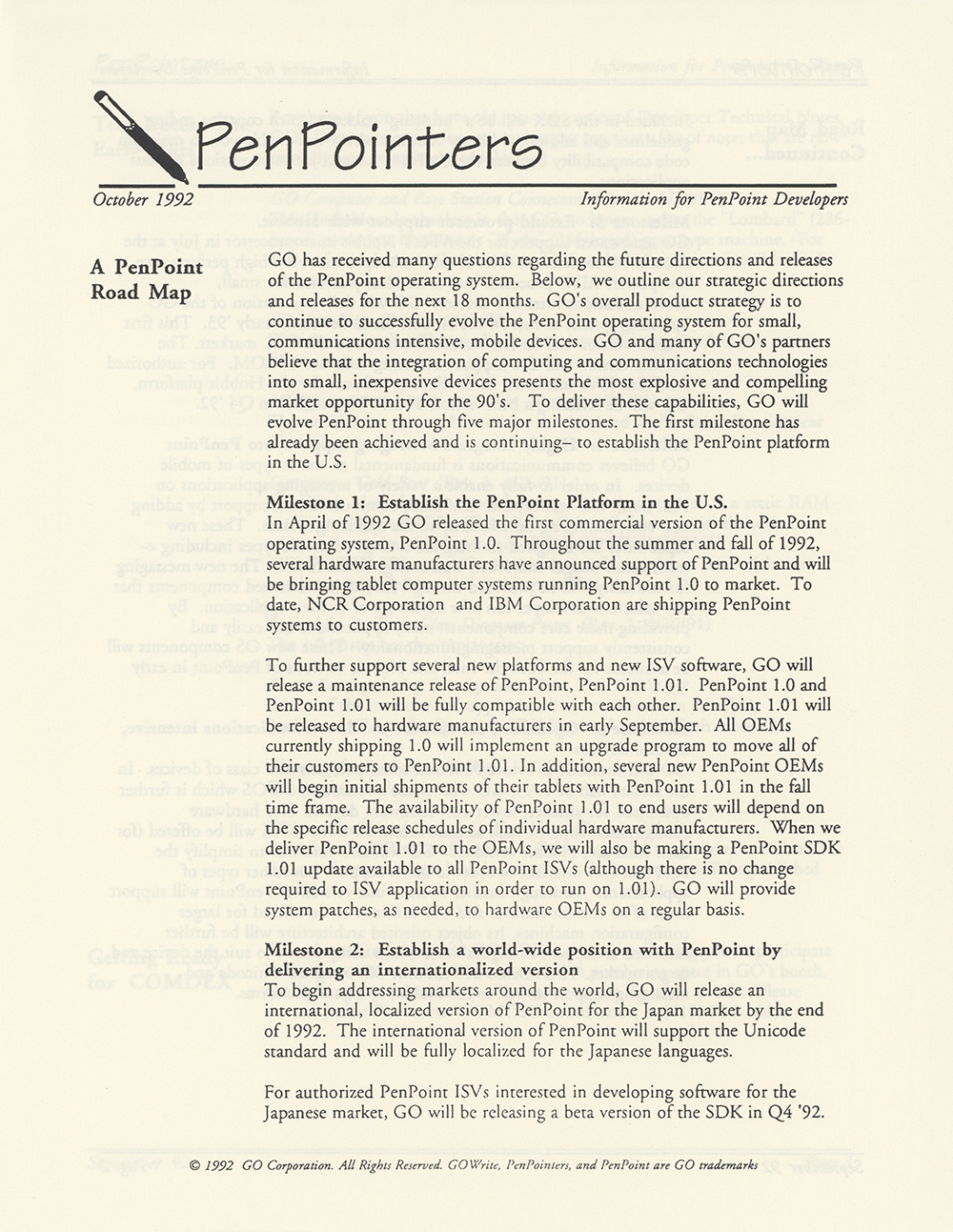
GO Corporation PenPointers October 1992 (Newsletter)
GO Corporation – Catalog of Products and Services (Letter)
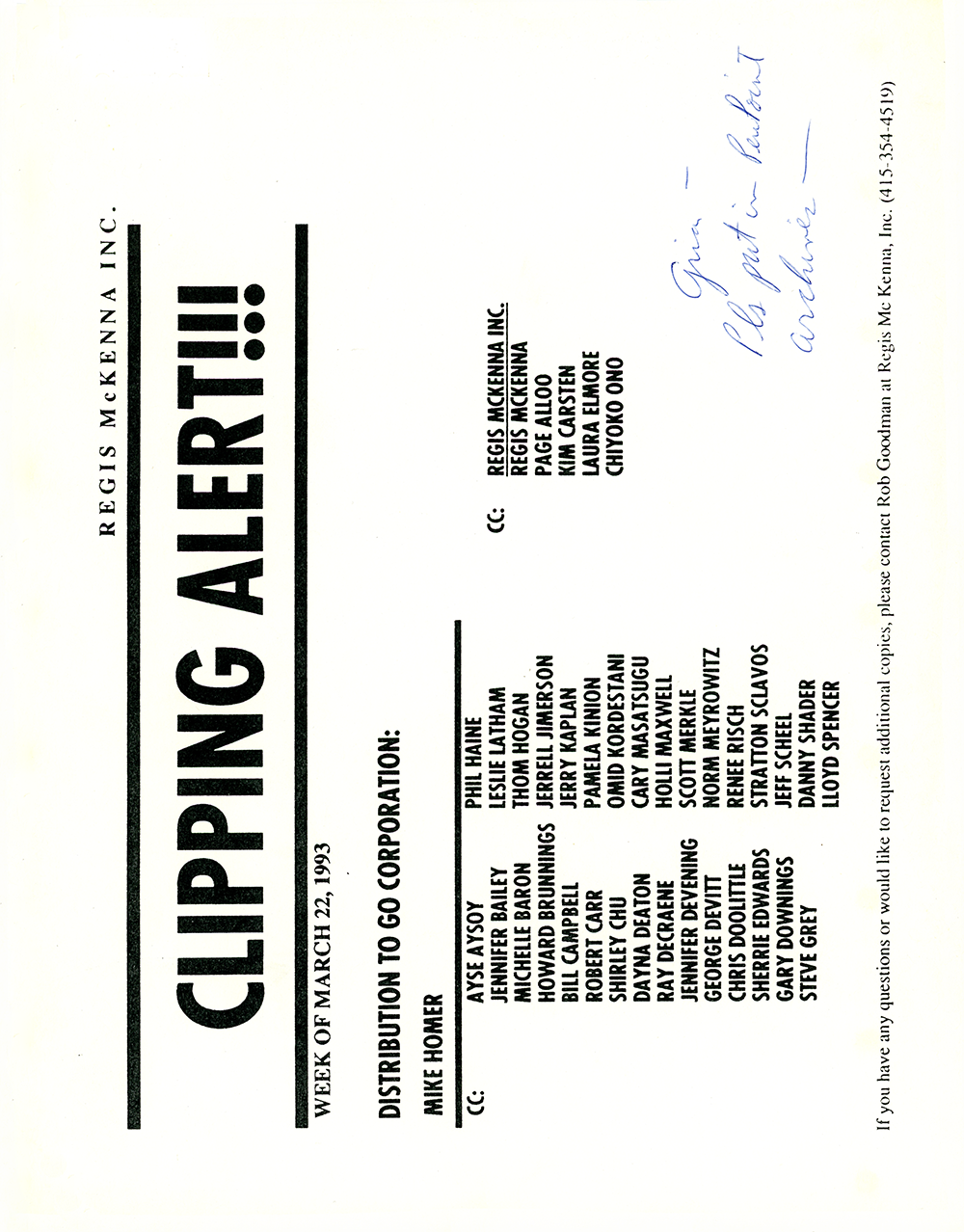
GO Corporation – Regis McKenna Clipping Alert (March 22, 1993)
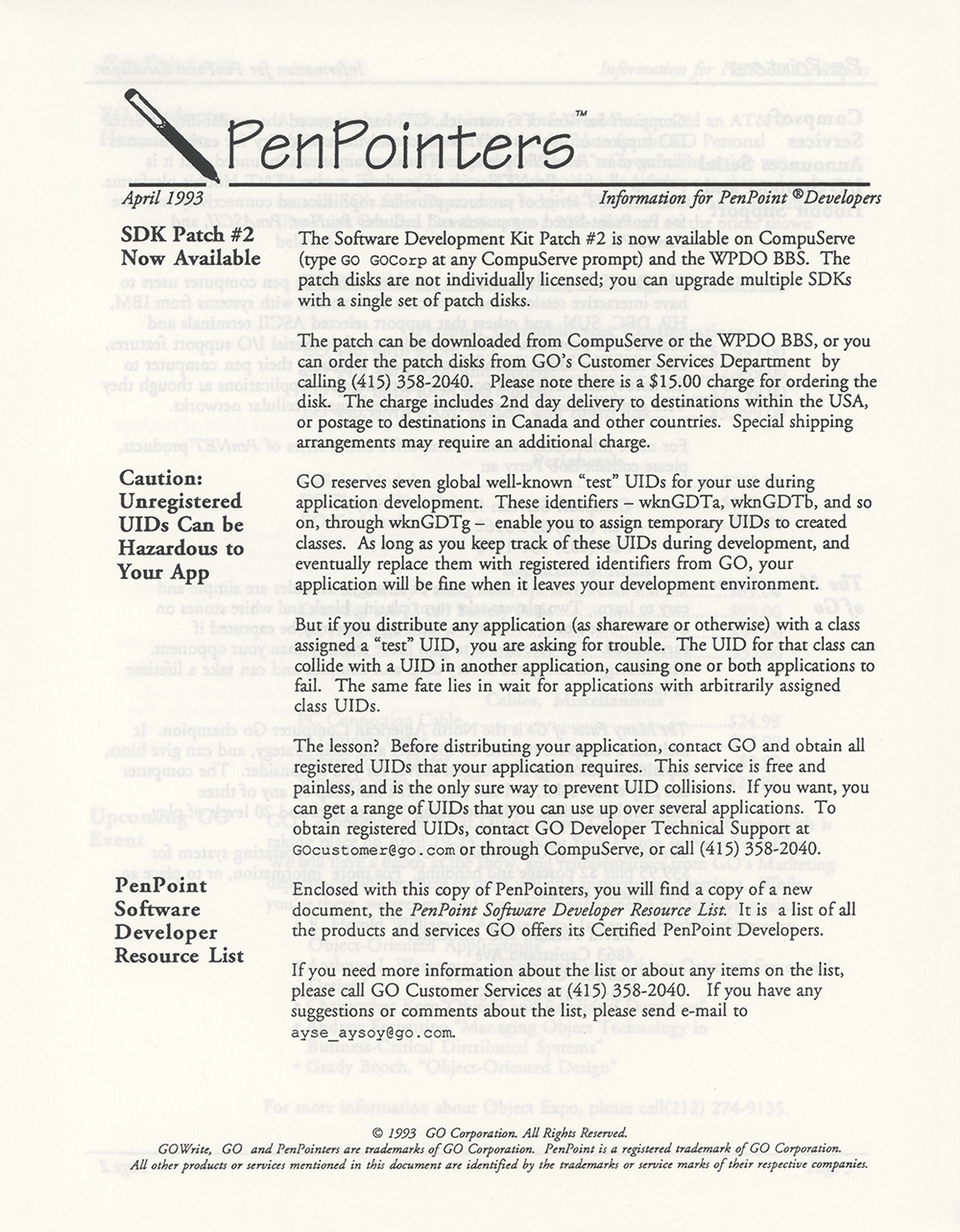
GO Corporation PenPointers April 1993 (Newsletter)
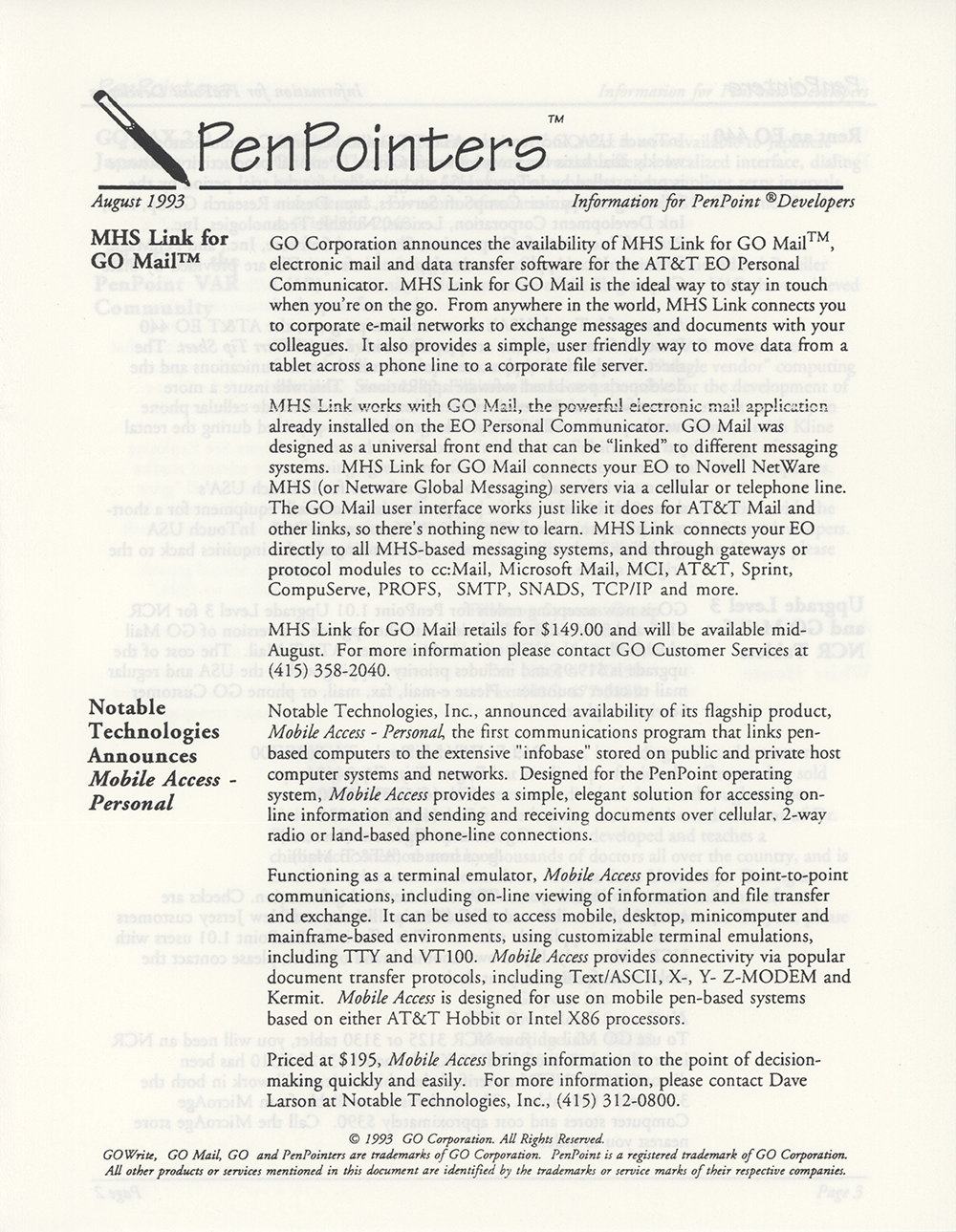
GO Corporation PenPointers August 1993 (Newsletter)
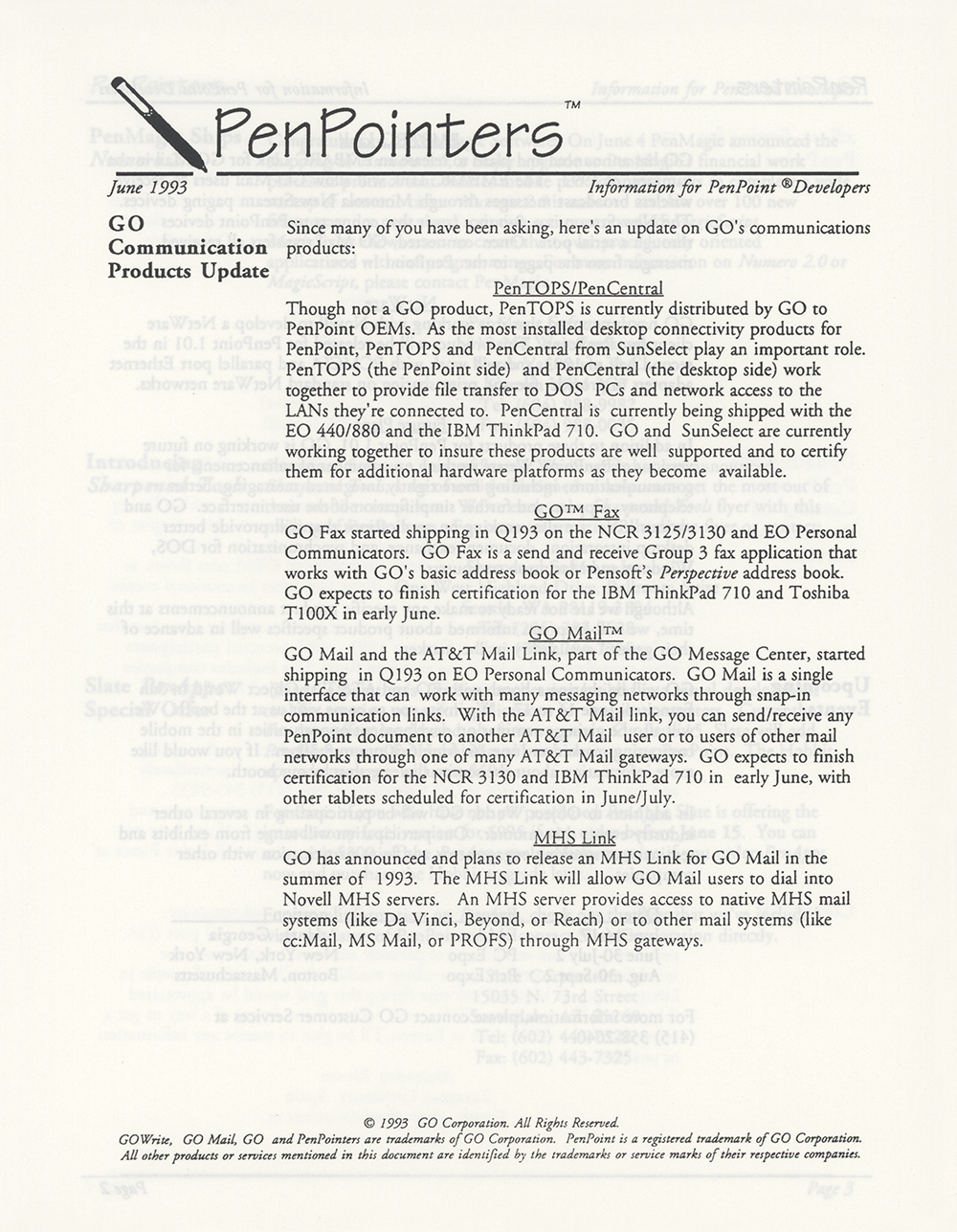
GO Corporation PenPointers June 1993 (Newsletter)
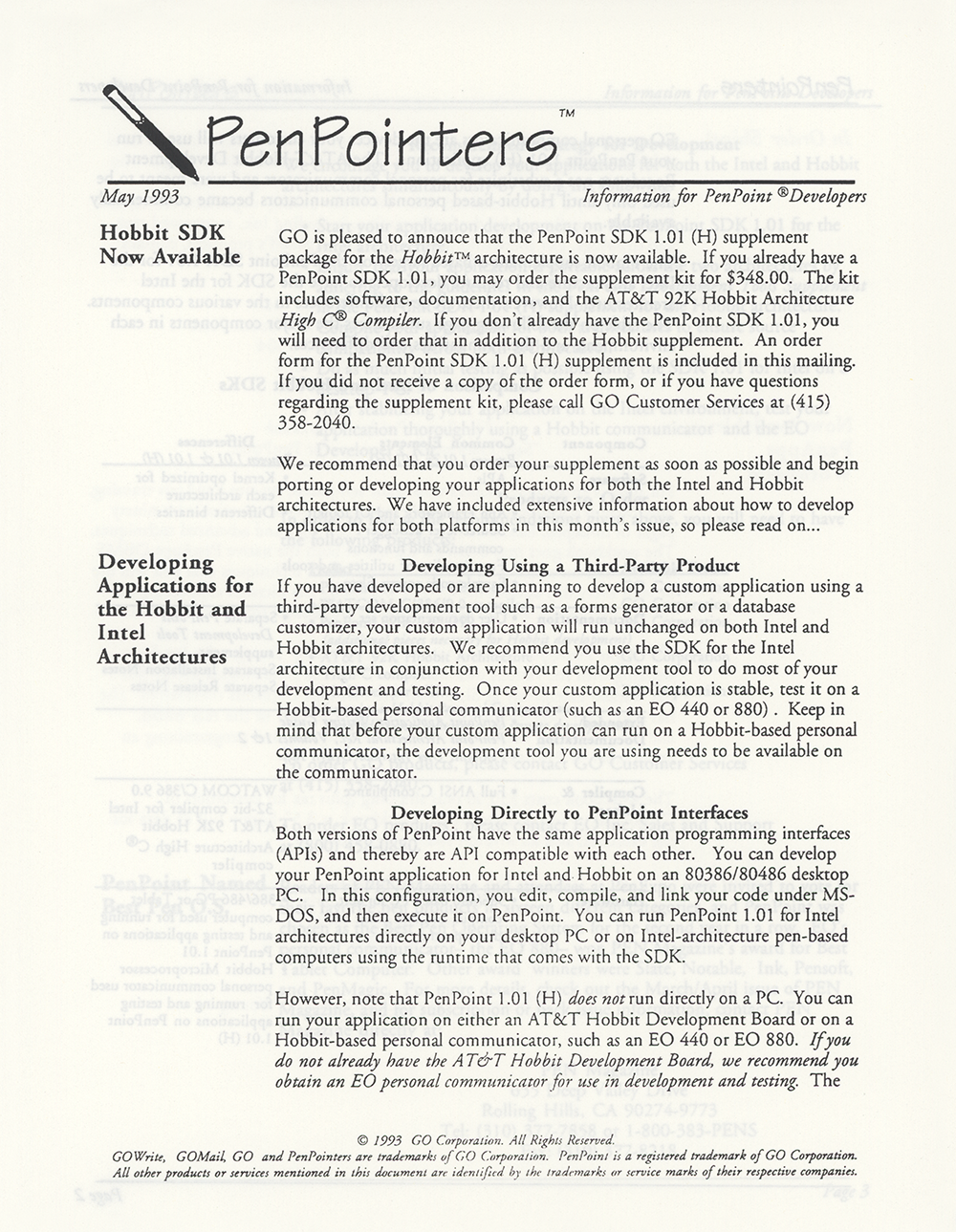
GO Corporation PenPointers May 1993 (Newsletter)
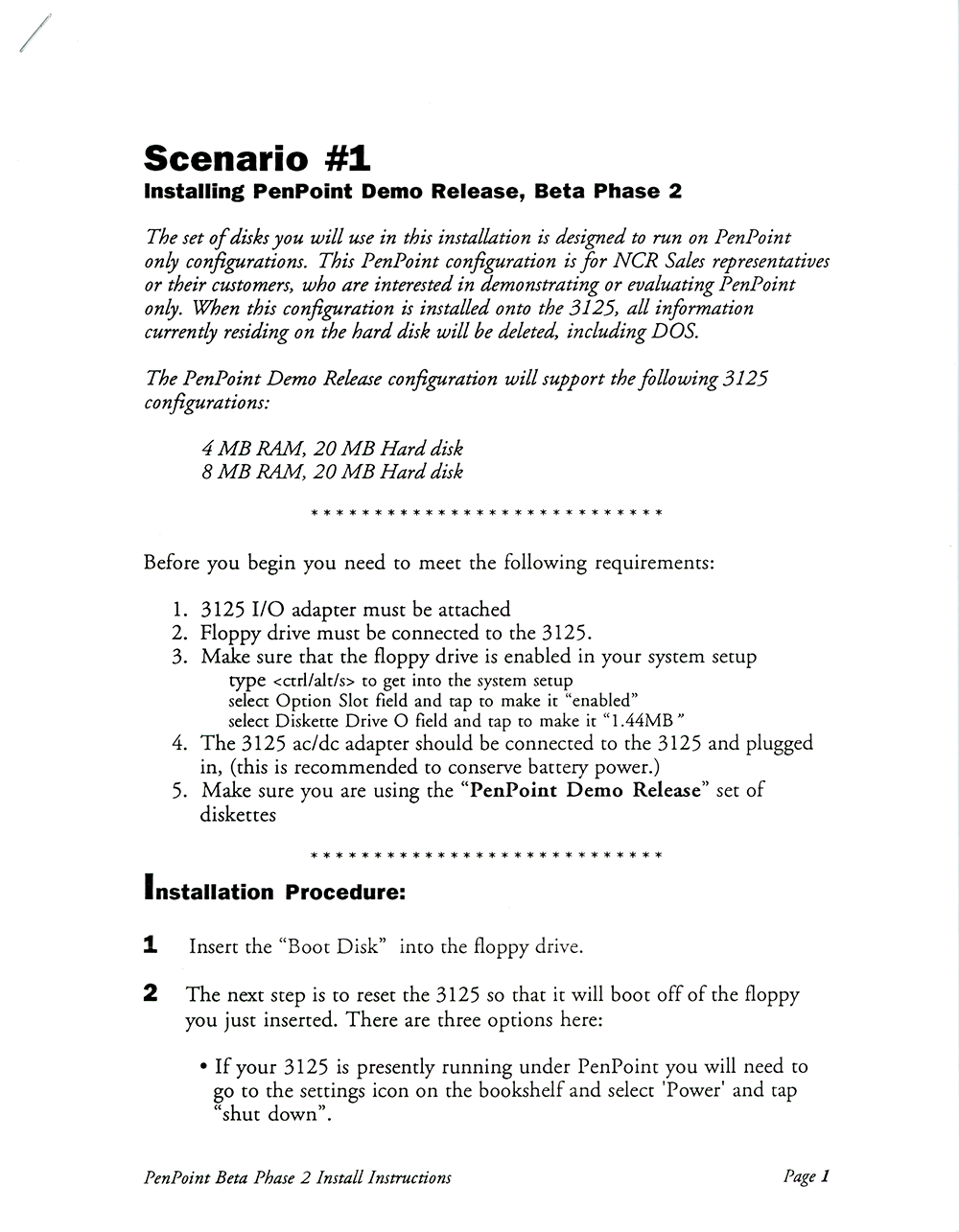
GO Corporation – Installing PenPoint Demo Release, Beta Phase 2
People

Editorial
No editorial content available yet.
Oral History
No oral history available yet.
Media
GO Corporation – Introducing PenPoint (1991)
GO Corporation used this video to promote the developer release of the PenPoint OS in 1991. PenPoint was one of the first operating systems designed specifically to run on mobile devices. Featuring: Dr. Norm Vincent (State Farm), Terry Conner (EDS), Phillipe Kahn (Borland), Jack Blount (Novell), David Reed (Lotus), Alan Lefkof (Grid), Vern Raburn (Slate), Dan Bricklin (Slate), and Jim Cannavino (IBM).
PenPoint Demonstration 1991
GO Corporation’s 1991 promotional video about their pen-based operating system, aimed at software developers. Includes an extensive demo by Robert Carr, architect of the operating system, where he shows the notebook metaphor, their use of gestures, the embedded document architecture, and more.
From: GO Corporation – Catalog of Products and Services (Letter)
GO Corporation – Introducing PenPoint (1991)
GO Corporation used this video to promote the developer release of the PenPoint OS in 1991. PenPoint was one of the first operating systems designed specifically to run on mobile devices. Featuring: Dr. Norm Vincent (State Farm), Terry Conner (EDS), Phillipe Kahn (Borland), Jack Blount (Novell), David Reed (Lotus), Alan Lefkof (Grid), Vern Raburn (Slate), Dan Bricklin (Slate), and Jim Cannavino (IBM).
From: GO Corporation 1993 Catalog of Product and Services Participation Request Form